

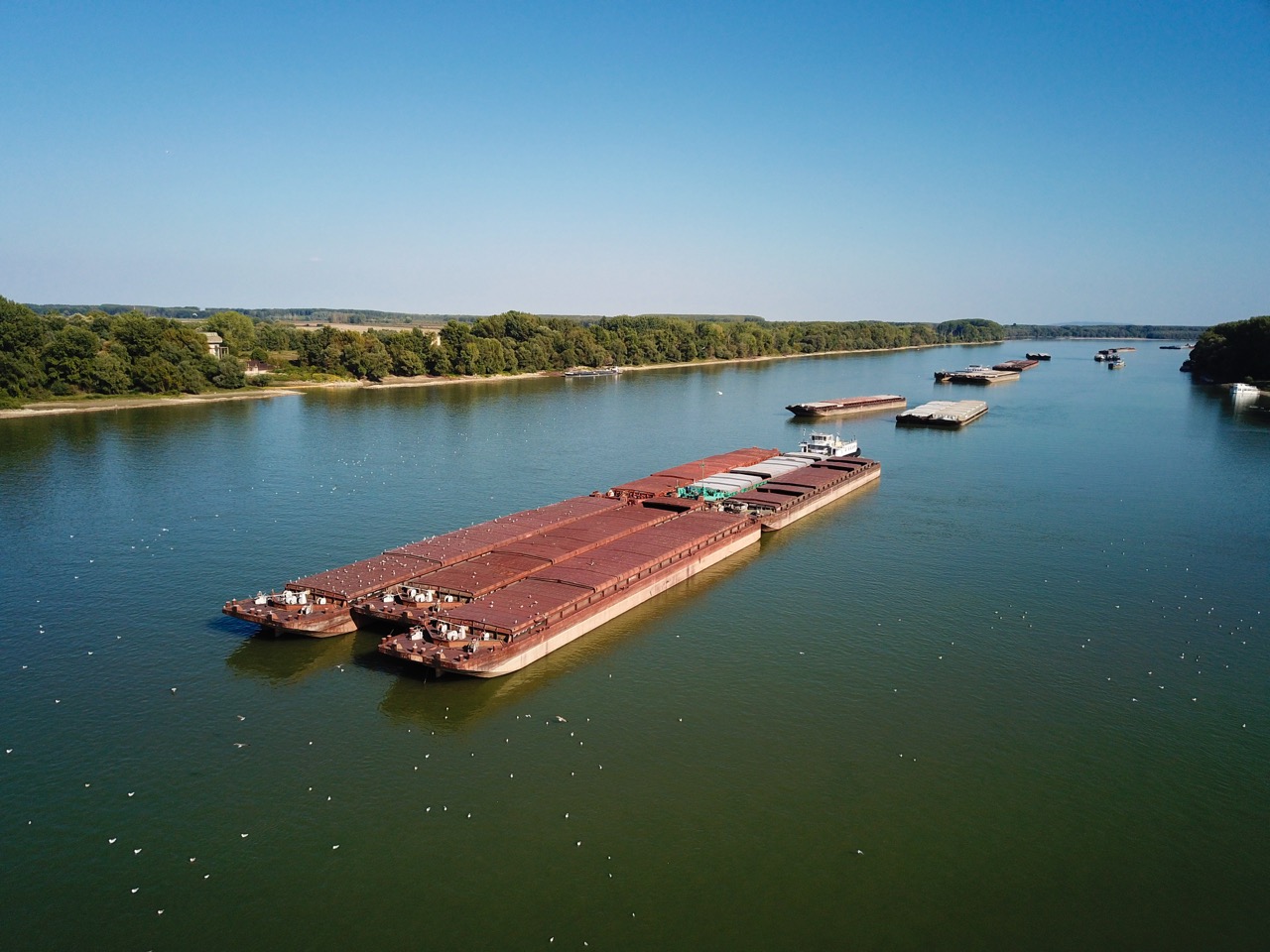
Barges remain one of the most efficient and scalable ways to move bulk commodities, even as global supply chains become more complex and competitive. While they often operate out of the spotlight, barges handle a significant share of the world’s energy products, agricultural exports, construction materials, chemicals, and industrial goods. Their ability to move large volumes at a low cost makes them a critical link in both domestic and international trade.
This blog examines the role barges play in global commodity transportation, how U.S. barge operations compare with systems in other countries, and how factors like tariffs, water levels and shifting trade patterns are influencing barge demand. It also draws on insights from OpenTug’s previous commodity series, where we explored barge usage across road salt, sand, oil and gas, grain, coal, coke and chemicals.
Transportation Built for Bulk
Across nearly every commodity sector covered in our series, the same truth emerges: barges make large scale transportation possible. Their capacity eclipses that of trucks and outperforms rail on a cost-per-ton-mile basis. They reduce roadway congestion, offer a smaller carbon footprint, and rely on established river and coastal routes that have quietly powered commerce for generations.
This is especially evident in agriculture and energy. In our earlier post on grain transportation, we highlighted how the Mississippi River System functions as the country’s primary export artery. The majority of U.S. soybeans and a large share of corn start their export journey on barges moving south toward Gulf terminals. When river levels are favorable, exports surge. This recent report suggests that rising water levels on the Mississippi have unlocked renewed export opportunity, with barge traffic recovering as navigational conditions improve. It’s a reminder of how tightly linked U.S. agricultural competitiveness is to the health of its inland waterways.
Energy shows a similar dependence. From tank barges moving gasoline and diesel between Gulf Coast refineries to inland routes supplying crude oil and natural gas liquids to domestic hubs, barges form a flexible and economical link between production regions and demand centers. Our blog on oil and gas underscored how barge routing often determines whether energy products reach export terminals efficiently or face bottlenecks further upstream.
Road salt is another commodity that consistently demonstrates why barges remain indispensable for bulk transportation. Every winter, states across the Midwest, Northeast, and Pacific Northwest move millions of tons of salt to ensure highways, bridges, and local road networks stay operational. Barges make this possible by delivering enormous volumes, often 50,000 tons or more in a single tow, directly to riverfront storage facilities and municipal docks. This scale keeps costs manageable for state DOTs and ensures inventory is in place long before storms hit. Barge transport is not only more efficient than over the road alternatives but also critical for supporting seasonal surges that could otherwise overwhelm truck or rail networks.
Industrial commodities like coal, coke, chemicals, and fertilizer round out the mix. As noted in our coverage of coal and coke, barges provide the scale and reliability needed to keep these dense, heavy materials moving steadily through domestic and international value chains. Taken together, these examples reveal a system where barges not only complement trucks and rail but enable transportation at volumes other modes cannot match.
Moving Goods Inland: Barges and Imports
Although the narrative around U.S. barge traffic often centers on exports, imports rely on barge transport just as heavily. Fertilizer bound for the Midwest, imported steel and minerals destined for manufacturing centers, and refined products for inland distribution all move from Gulf or East Coast ports toward the interior by barge. For many shippers, using barges prevents terminal congestion and reduces the number of truck or rail transfers needed to reach inland destinations. In a market where labor shortages and infrastructure constraints are common, these advantages preserve both reliability and cost-control.
Trade Policy, Tariffs and the Shifting Terrain of U.S. Waterways
The past several years have introduced a wave of uncertainty for U.S. shippers as tariffs, port fees and trade policies have reshaped cargo patterns. For commodities tied heavily to global markets, like soybeans, tariff changes often translate directly into fluctuating barge demand. Operators have reported growing concern that rising port fees could erode the cost advantage long associated with inland waterways, making careful lane planning more essential than ever.
And volatility is not limited to economics. Water levels, dredging schedules, and infrastructure conditions also influence the reliability of barge routes. A natural shift, such as water returning to seasonal norms, can immediately improve export throughput. When these conditions deteriorate, shippers feel it just as quickly.
A Global Comparison: How the U.S. Measures Up
While the U.S. inland waterway system is relatively sophisticated, it is far from the only region where barges play a defining role. Brazil, Europe and China all offer a compelling perspective.
In Brazil, rainfall has recently revived grain-barge navigation along key Amazon basin routes after severe drought reduced capacity and halted shipments. Grain barges on the Tapajós and Madeira Rivers have resumed operations at roughly half capacity as water levels recover; an improvement that is critical for the country’s soybean and corn exports. Northern Brazilian river ports like Barcarena and Santarém are increasingly significant in global grain flows. In 2023, they handled more than a third of Brazil’s soybean exports and nearly half of its corn shipments, underscoring how central barge transport has become to the nation’s rise as an agricultural powerhouse.
Europe presents a different picture, shaped by well-established canal systems and robust policy support for low-emission transport. The Rhine and Danube serve as commercial corridors for chemicals, petroleum products and industrial goods. China continues to expand its inland waterway capacity along the Yangtze River, via fleet modernization and green bulk carrier initiatives, and uses this system to transport large volumes of coal and grain, among other commodities.
Against this global landscape, the U.S. stands out for its wide geographic coverage and diverse commodity mix. Yet it also faces distinct challenges, including aging infrastructure, tariff-driven volatility, and increasing competition from rising agricultural exporters like Brazil, whose barge corridors face similar challenges, but are also getting stronger over time with strategic investments.
The Strategic Importance of Barges in a Changing Global Market
What becomes clear, whether looking at the Mississippi River, the Amazon, the Rhine or the Yangtze, is that barges offer something increasingly rare in global logistics: stability at scale. They provide a buffer against fluctuations in truck availability, rail congestion, and fuel prices. They can carry the volumes required to meet rising global food and energy demand. And unlike other modes, they do so with comparatively low emissions and with infrastructure that has already been paid for many times over through decades of use.
For U.S. operators and shippers, this means that barges remain essential, though not guaranteed. As fee structures shift, water levels fluctuate, and global competition intensifies, the industry must continue investing in resilience. The lessons from Brazil’s drought recovery and the Mississippi River’s seasonal fluctuations demonstrate how sensitive commodity flows are to natural conditions. Meanwhile, trade policy shifts remind us that economic forces can alter barge demand as quickly as weather can.
Now the challenge lies in strengthening this network through modernization, digital connectivity, improved transparency, and infrastructure support. Platforms like OpenTug play a role in that evolution by connecting operators, shippers and equipment in ways that make inland logistics more predictable and efficient. Reach out to our team today to learn more!

.png)
